
My Mission at the End of a Fascinating Project
At the end of a compelling project, my client gave me a task. I needed to train and certify a dozen managers and trainers. The goal was for them to become qualified Agile Coaches. This title demands significant experience, primarily in organizational development.
Alongside the training, I provided targeted coaching support, revealing a critical insight: direction matters. Without a clear destination, efforts are wasted, and confusion spreads. Knowing where to go and how it looks when achieved is essential for meaningful progress and optimal investment.
The organization was inspired by the NextGen model from Stern Steward. This model is highly relevant in the era of multi-sided digital platforms—think Airbnb. Such platforms facilitate autonomous interactions between buyers and sellers under established rules.
NextGen
NextGen mirrors this model by integrating a platform, a plexus (governance structure), and swarms (projects). Its core principle is a holistic management approach. This approach blends the stability of a traditional organization with the flexibility required for innovation. It embodies an entrepreneurial, lean structure with a “venture capital” mindset.
The plexus acts as governance, aligning internal ventures and project swarms with company goals, balancing control with strategic investment. It prioritizes automation of routine transactions, which accounts for most company activities.
Swarms represent non-standard projects or programs—acknowledging that real-world initiatives are rarely routine but often unique and complex.
The platform manages core transactions and automates processes, creating a foundation for scalability and efficiency.
Key Principles of NextGen Governance (from an AO perspective):
- From traditional function and process focus to a clear process-driven priority within the platform — unbundling classic matrix structures
- From fully integrated matrix setups to clearer hierarchies (e.g., division versus country)
- From intricate RACI tables to practical Limits of Authority (LoA), enabling agility over rigid organization
- From multiple hierarchical layers to high proximity to business through delayering
- From functional silos to broader managerial impact via increased span of control and shared accountability
- From numerous full P&L units to managing costs at the source, transforming cost centers into profit centers
Platform Characteristics
- Stable, structured, and highly efficient
- Standardized end-to-end process organization
- Deployment of advanced robotics and AI
- Leveraging scale, scope, skills, and speed
- Organized consistently around core, end-to-end processes
This approach ensures that the platform operates seamlessly, supporting an agile, scalable, and future-ready organization.
- From an AO (agile org model), platform refers to “structure”.
PROJECT SWARM
An agile project and network organization that embodies flexibility, adaptability, and responsiveness. Designed for complex, temporary, innovative, and distributed solution approaches, swarms operate on principles of agility, self-management, and open-source collaboration.
In this model, project tasks and resources are extracted from traditional administrative functions and go-to-market units. Then, they are reassembled into a dynamic, decentralized structure. This forms a “swarm” of autonomous teams.
From an Agile Organization (AO) perspective, swarms represent organization in its most flexible and adaptive form.
With this understanding, the digital enterprise resembles the illustration below:
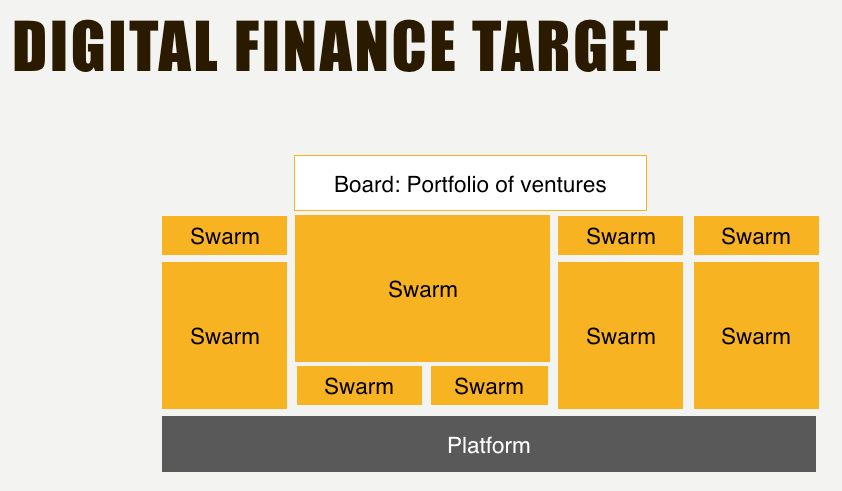
Organizational Structure Overview
At the top of the organization, the Plexus oversees strategy, budgeting, and maintains the organizational boundaries. It functions as the guiding governance layer.
The platform, due to its automated nature, should occupy minimal space in terms of people and budget. Most activities are to be carried out by swarms, which represent the bulk of operational work.
This setup is an evolution of the NextGen model, incorporating a quantification of its three core elements.
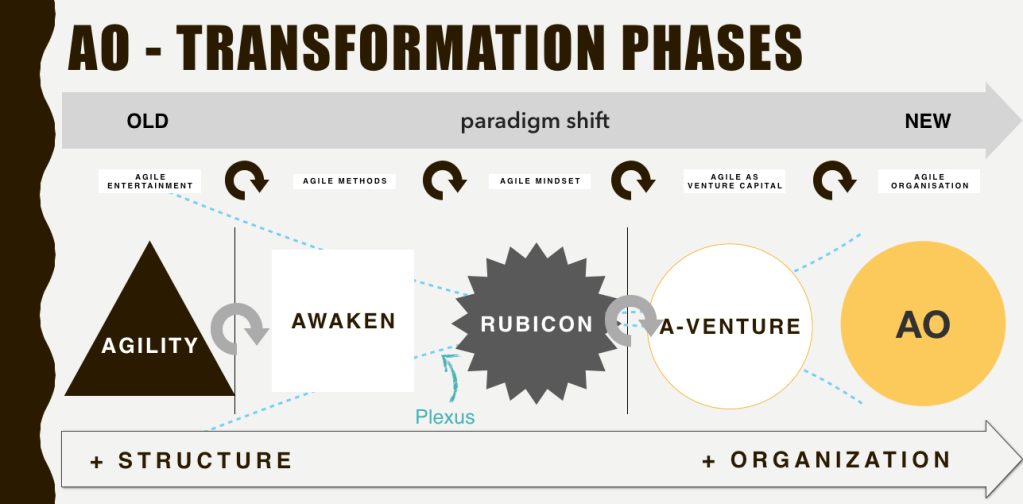
With this understanding, my proposed organizational roadmap is as follows:
| 2019 | 2020 | 2021 | |
| Plexus (Board) | 10 % | 10 % | 10 % |
| Platform | 89 % | 70 % | 50 % |
| Swarms | 1 % | 20 % | 40 % |
Please take into account that the organization is worldwide and 4500 people big.
The Stern Steward model in AO words.
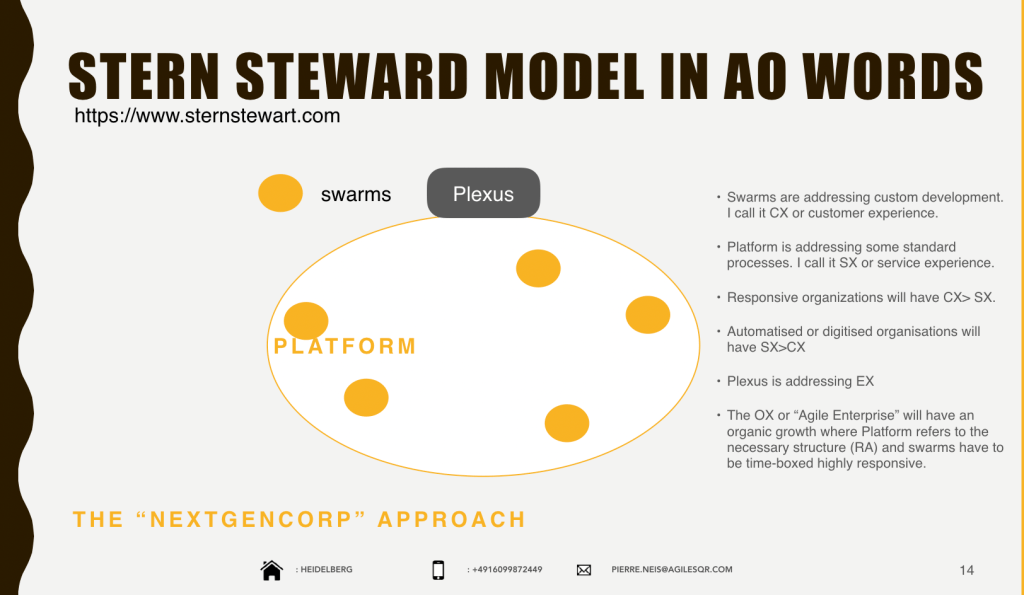
- Swarms focus on custom development, addressing Customer Experience (CX)—the direct interactions and value delivered to paying customers.
- The Platform handles standardized processes, representing Service Experience (SX)—the operational backbone that enables repeatable, scalable services.
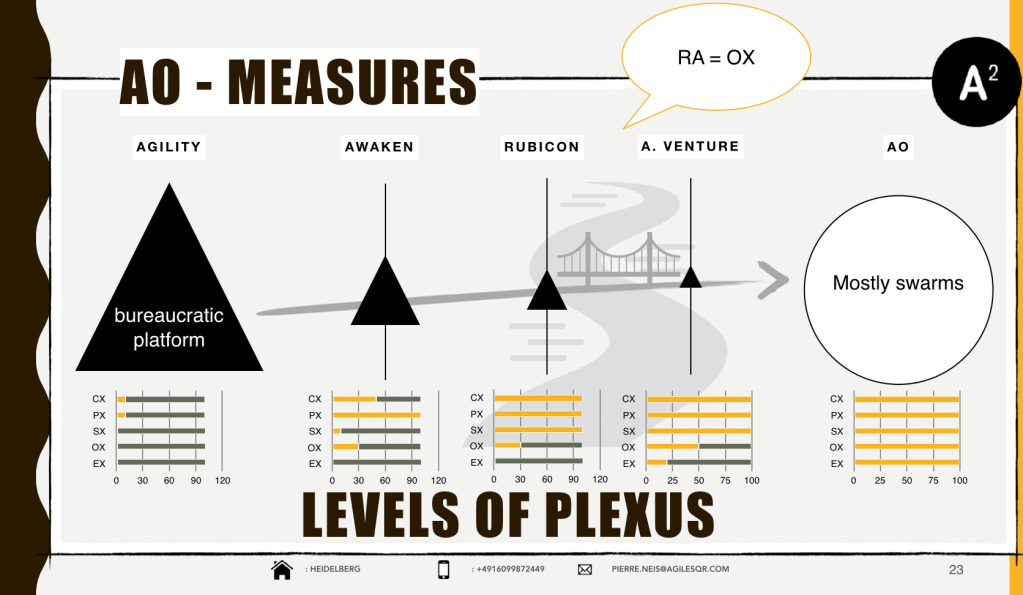
- In responsive organizations, CX > SX, emphasizing direct customer engagement and tailored experiences. Conversely, highly automated or digitized organizations tend to have SX > CX, prioritizing efficiency and on-demand service delivery.
- CX addresses the external customer seeking specific outcomes. SX stems from CX. It provides the industrialized services that support those outcomes.
- Plexus is concerned with Enterprise Experience (EX)—the overarching strategic and cultural foundation.
- The Organizational Experience (OX), or “Agile Enterprise”, is characterized by organic growth where the Platform provides the necessary structure (e.g., Requisite Agility), and swarms are highly responsive, often time-boxed, to adapt swiftly to changing demands.
The Organizational Process through AO Dynamics
AO System Organizational Model
At the heart of the agile system’s dynamics is a focus on organic, nature-inspired behaviors rather than rigid methodologies. The organizational model is based on flocking behavior theory, exemplified through a swarm perspective:
- Single-team (Swarm) Concept:
Visualize the organization as a swarm—where individuals (birds or fish) work collectively toward shared goals. The figure illustrates this from a single team’s perspective. - Separation:
Members leave the platform (matrix) to dedicate their attention fully to the swarm. Once goals are achieved, they can choose to detach. This action emphasizes that the swarm exists solely to generate value—not to retain members. - Alignment:
Alignment is critical—it aligns with Hoshin Kanri principles of strategic deployment. Every agile activity, from strategic roadmapping to daily stand-ups, ensures everyone’s efforts are synchronized. - Cohesion:
The team functions as a cohesive system, not just a sum of individuals. A strong sense of unity reduces fear and fosters collaboration—much like flocks of birds or schools of fish. Virtual teams are not effective in this model; physical or cohesive proximity is key. - Avoidance:
Teams operate smoothly from start to finish, moving in unison without obstacles or distractions. Their trajectory remains focused and unified.
Multiple Systems Crowd Model
In larger organizations, behavior resembles a small team but with varied paces. Typically, the natural cycle for any size organization is roughly three months.
Based on flocking theory, roles can be likened to different bird types:
- Sallies:
The core team members or developers who actively pursue tasks. - Gleaners/Floaters:
Support personnel from the broader platform who assist intermittently—contributing rather than performing core tasks.
AO Principles (Comparable to NextGen Agile)
- Team Dynamics:
Members frequently shift positions relative to six or seven surrounding team members—similar to “pizza teams.” - Self-Organization:
Teams organize themselves without strict external control. - Emergence:
Behaviors and shared values develop spontaneously through swarming actions. - Stigmergy:
Continuous improvement driven by shared environment cues—akin to weather patterns influencing behavior. - Planning & Control:
Minimal formal planning is required; sprint planning aligns efforts rather than controls them. - Collaboration:
Focused on effective communication through agile meetings only.
Goals & Outcomes
The process fosters the appearance of coordinated teams emerging naturally from individual, self-serving behaviors—transforming independent individuals into unified groups.
Collective behaviors shape emergent intelligence.
Swarms facilitate dynamic, decentralized collaboration—without top-down direction.
Enhanced mechanisms for transmitting ideas and establishing new connection patterns help teams move closer together, reducing risks.
 AO – Adaptive Organizations
Leave a comment