
Measuring an Agile Enterprise: A Conversation at the Whiteboard
I collaborated with a client to design the vision of his organization as an agile enterprise. During this process, a key question arose: How do we measure it? Standing in front of a whiteboard, I began to unpack this by explaining the different layers of experience within an organization:
- UX (User Experience): This is what users expect when they interact with your solution—improving usability and creating delight. Think of why people love using iPhone or Apple computers. The strategy here is to enhance accessibility—like accessing all your apps with a single thumb.
- CX (Customer Experience): This encompasses the series of actions that build trust between the enterprise and its customers. It’s about caring first and foremost for customer needs, not just enterprise requirements. CX is a personalized, unique relationship that involves hospitality and genuine engagement—a tailored experience for each customer.
- SX (Service Experience): This pertains to a collection of services, tools, and processes that are automated for customer use. Think of it as an evolving catalog of standards. These standards can be easily scaled or automated. They leverage insights from CX to continuously update and improve service offerings.
- PX (People Experience): This involves actions designed to foster motivation, psychological safety, openness, and co-creation. In optimal scenarios, it’s about creating environments like “Kawaii culture.” Cute images of animals or babies evoke empathy. They boost morale. Gamification is another approach that reduces fear and unleashes creativity during problem-solving.
- OX (Organizational Experience): The context in which CX and SX are created—the system, team, or process. In complex systems theory, OX is the “safe-to-fail” environment, such as a team, sprint, or organizational structure. The goal in Agile Organization (AO) is emergent, bottom-up reorganization, fostering meaning and adaptability. Conversely, top-down control tends to suppress innovation and flexibility.
- EX (Enterprise Experience): The highest level—defining the purpose, wisdom, and values of the enterprise. It guides the entire system. Steve Jobs exemplified this with his “North Star” mission. He wanted to put a ding in the universe. This vision inspired Apple’s innovation and culture.
| CX | Customers are integral to the system; they can both contribute and consume. The system is designed to allow customers to shape the agenda, embodying the core principle of Open Space Technology. | |
| SX | Games, tools, stickies, paper, pens, Lego, etc., food, beverages, etc.… | |
| PX | Attendees should feel free to experiment in a playful and joyful atmosphere. | |
| OX | The organization is fluid and provides only a platform with simple rules. Mentors and support from the whole community are equipped to organize an event. | |
| EX | The Board is light: only the three founders. Freedom is given to every city to organize themselves. Core values have to be respected. The community gets full support from the Board whenever they ask. | Core values: – you have to attend one Play14 before organizing one. – No “rockstars” are allowed. Even if you are a “rockstar” in Play14, you are like any other, and you have to pitch your session. – Respect and tolerance are crucial. – No business usage is allowed. It is a non-profit organization. You can use what you learned. However, you cannot use the brand for your marketing. |
How a Play14 Begins and Unfolds
Each Play14 starts in the afternoon. The first day is dedicated to socializing—an essential step to building connections before diving into the activities. This typically involves about two hours of icebreakers, introductory round tables, and explanations of the open space technology rules. The organizers set the stage and share the simple rules. They invite those interested in facilitating sessions the next day to step forward. At this point, the organizers hand over the event to the participants. The participants take charge for the remaining days. They continue until the closing session. The day concludes with a corporate dinner in the conference room.
The Main Days: An Agile and Engaging Open Space
The following days are structured entirely around the open space format. This is one of the most flexible and engaging ways to facilitate collaboration.
Each day begins with icebreakers and warm-up activities led by volunteers. In the main room, a large board displays time slots and rooms, and the open space rules are reiterated:
- The Law of Two Feet: If you feel you’re not contributing, move to a space where you can add value. If you feel you’re not learning, move to a space where you can add value. Use your two feet to gain something there.
- Four Principles:
- Whoever comes is the right people.
- Whatever happens, is the only thing that have.
- When it starts is the right time.
- When it’s over, it’s over.
These rules are simple. They are designed to support self-management. However, some participants struggle to avoid micro-managing the schedule. This happens even with good intentions. Such behaviors become visible within the system, often prompting collective laughter and empathy.
At the end of each day, the facilitator gathers everyone for a debrief and retrospective. They encourage open sharing of experiences. They also suggest organizational improvements. Once this is complete, facilitators are invited to volunteer for the next day’s sessions.
The following day follows the same flow, but at the end, the organizers take over to close the event.
From an AO Perspective, What Do We Observe?
| Separation | Socializing, icebreakers and warm-ups are “separating” the attendees from their “normal” life. “Law of two feet” is allowing a natural separation process. |
| Alignment | The open space board with time boxes and the agenda of the day is visible for everyone. That board is the main alignment point for the two and a half days. |
| Cohesion | Socializing, location, and meeting “ceremonies” like warm-ups and retrospectives |
| Avoidance | Open space rules like the law of two feet. |
| Simple rules | Only open space rules. EX rules are only for organization purposes. |
| Self management | People are designing their agenda, and nothing is mandatory. |
| No central coordination | During the event, central coordination is handed over to the open space board. Even the organizers can attend the event as players. |
| Emergent behavior | Retrospectives help to improve the organization based on emerging behavior. The conference design provides a nudge to experiment. Socializing is usually very extreme in “craziness” that will be adjusted through the next days delivering options. Behaviors are different from one city to another. For instance, Hamburg loves to sing. Barcelona loves to build towers with people. London likes experimenting with new games. Madrid and Lisbon are just crazy. |
Organizational dynamics (system):
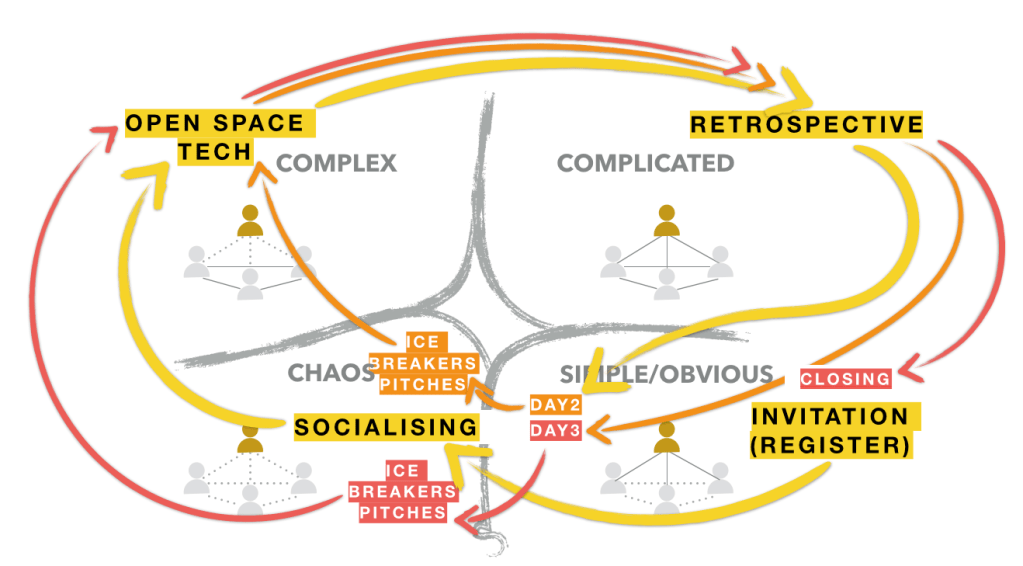
Understanding the Evolution of Organizational Dynamics Through Agile Systems
The invitation and registration process for Play14 are inherently straightforward; they are “obvious.” The event’s socializing phase introduces necessary “chaos,” allowing everyone to bring their ideas openly. This phase exemplifies the “complex” domain, where time-boxes serve as self-managed, “safe-to-fail” containers—people organize themselves without external control. The day unfolds until the time runs out. At that moment, everyone gathers for a retrospective. They shift into the “complicated” phase as reflections and adjustments occur.
The call for facilitators for the next day indicates a shift back into “simple” mode. This closes each cycle and repeats twice until the event concludes. This cyclical process aligns with principles of Agile Systems Dynamics or the Cynefin learning loop, emphasizing continuous adaptation and learning.
Play14 as a Tested for Agile Organization (AO)
Play14 embodies the core concepts of AO—taking a flexible, emergent approach to organize and innovate. This method was initially explored in 2012. Erik Chapier-Maldague’s sKale project focused on HR-centric co-evolution and self-organization within financial institutions in Luxembourg. The idea was to create an internal market for projects. In this market, ideas emerge and be proposed under simple rules. One such rule was convincing at least five people to join.
This approach mirrors AO’s broader philosophy. The enterprise transforms into an open ecosystem. Individuals identify opportunities and act on them without waiting for approvals. They self-manage based on the Result, Only Work Environment (ROWE) model. People work when and how they choose and are paid for results. While economically appealing, this model risks resembling a freelance marketplace, lacking the inherent enterprise experience unless balanced carefully.
In practice, models like work-from-everywhere—as seen at SAP—combine flexibility with a degree of accountability. These models foster self-management and commitment within a low-structure, high-trust environment.
Deepening the Business Model with the X Framework
Using the X framework—EX (Enterprise), OX (Organizational), PX (People), SX (Services), and CX (Customer)—we can analyze organizational dynamics:
- EX (Enterprise Experience): Defines the organizational’s core purpose, values, and identity. Many organizations are EX-centric, prioritizing the company’s reputation and internal identity over customer or people needs. For instance, I often prefer to redirect the question “Are you proud to work here?” to “I value the people I work with,” emphasizing the human element over corporate pride.
- OX (Organizational Experience): Refers to the structure and systems—bundles of independent units or teams working toward shared goals. These are often well-defined systems. However, communities of practice or chapters introduce a “complicated” behavior pattern. This is rather than a true system.
- PX (People Experience): Centers on the behaviors and interactions within the system. It’s chaotic by nature—embracing diversity, high engagement, and experimentation. In authoritarian environments, PX diminishes, while in EX-centric organizations, it can be cultivated through methods like nudging or empathy.
- SX (Service Experience): Represents the service offerings delivered to customers. Many organizations describe themselves as “service companies,” but often the activities are confined to back-office functions, disconnected from customers. High-performing SX organizations measure ROI and operate profit centers, maintaining responsiveness and customer focus.
- CX (Customer Experience): The ultimate goal—the value and trust built with external customers through seamless and personalized interactions. A fully customer-centric company minimizes unnecessary internal work, automates where possible, and outsources non-core activities.
Evolving Organizations Toward Better Alignment
In the next section, I will explore how these models intersect. I will also examine how organizations can evolve from one to another. Adopting strategies aligned with their current state helps them progress toward a more balanced and responsive organization.
 AO – Adaptive Organizations
Leave a comment