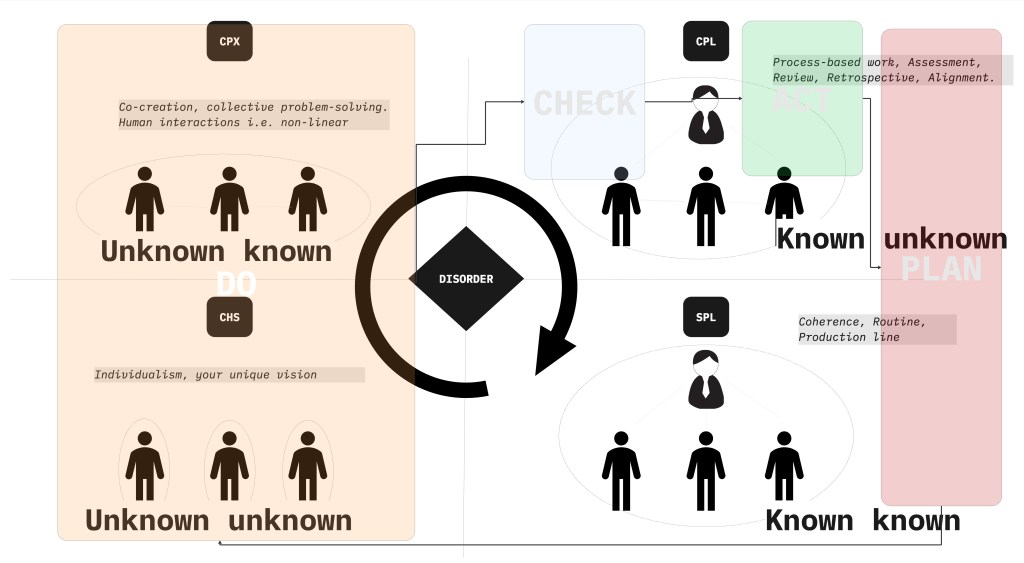
Agile Systems Dynamic Model describes “agile” as the evolving behavior of a complex social system rather than a static framework. The key elements focus on agents, their objectives, and how their interactions generate adaptive patterns over time.
Focus on agents and objectives
- The model emphasizes agents (teams, leaders, PMO, customers, etc.) and their often non‑aligned objectives instead of linear cause–and–effect chains; conflicting priorities are treated as normal system conditions.
- Understanding agile means understanding how these agents negotiate, cooperate, and compete over time, not just which practices they use.
Dynamic iteration concept
- “Iteration” is generalized. It can be a sprint or a project phase. It even be an annual portfolio/PMO cycle. The only requirement is a recurring inspect‑and‑adapt loop.
- The same dynamic model can be applied at multiple levels (team, project, program, PMO). This application reinforces recursion as a design principle.
Cynefin‑inspired behavior modes
- The model borrows from Cynefin. It shifts attention from categorizing problems to observing behaviors in different domains (obvious, complicated, complex, chaotic). These are examined as system states.
- In “obvious”, agents lean on best practice. In “chaotic”, they improvise just enough structure to move. In “complex”, they engage in sense‑making and co‑creation to let patterns emerge.
Complex adaptive system view
- Agile is framed as a complex adaptive system. It embraces diversity and builds on commonalities. It is not a uniform, standardized process.
- Data and experience precede patterns. Sense-making from real interactions comes first. Then patterns or methods are chosen or adapted. Patterns are not imposed upfront.
Growth by assimilation, not colonization
- Change is described as “growth by assimilation”. New practices, units, or acquisitions are absorbed by the existing system. The system is reshaped by them.
- The model warns against “colonizing” transformations. These occur when a predefined agile model is rolled out without allowing local adaptation. This approach can lead to rejection or shallow compliance.
Organizational design implications
- An “agile organization” is conceived as a collaborative platform. It automates routine work. This automation frees people to continuously recreate the organization around value creation.
- Forms of work such as platforms, plexus, programs, projects, and swarms are seen as evolving structures. They express the underlying agile system dynamics rather than fixed end-states.
Using the tool
- In the book “The New Normal: AO Concepts and Patterns of 21st Century Agile Organizations,” work is studied from two directions. The first examines how work is accomplished. The second considers what work is accomplished. One direction focuses on how work is accomplished. The other direction examines what work is accomplished. The first perspective is how work is accomplished. The second is what work is accomplished. Highly regulated and expert tasks focus more on Complex and Simple (linear) work. Highly responsive work emphasizes Chaos and Complex (non-linear, self-organized).
- There’s a distinction between the how and the what. Expertise, regulation, compliance, and risk management generally involve linear processes, while projects and swarm work are often non-linear. For example, contracting is typically linear. It aligns with the Act, Complicated, and Simple stages. On the other hand, customer relationships are non-linear. They involve Do, Chaos, and Complex phases.
- This distinction links closely with the PDCA (Plan-Do-Check-Act) cycle. Continuous improvement and learning are inherently non-linear, transitioning from individual chaos to cocreation within complex systems. Analyzing outcomes and making decisions occur in the Do and Check phases. These phases then inform planning for simpler activities. The activities in the Plan phase are more predictable.
KPI
- A high-performing organization can have: 80% Complex work, 10% Complicated, 5% Simple, and 5% Chaos.
- A bureaucratic organization often exhibits: 0% Complex, 80% Complicated, 5% Simple, and 15% Chaos.
This distribution reflects the organization’s agility and capacity to navigate different types of work and system states.
 AO – Adaptive Organizations
Leave a comment