From time to time, I use AI to get some feedback on the questions bubbling in my mind.
Why use AI? Everyone uses these tools. I am curious to know what people might think about the method. I want to make some adjustments based on that feedback.
I am part of Open Eyes Collective. It is a think tank focused on Org design and new work. I am surrounded by colleagues who are experts on VSM. I wanted to avoid academic controversies. My dear friends are keynoting at Agile Conferences. So, I decided to pinch my friends through a comparison between VSM and AO.
For those who don’t know both, let me summarize it:
- VSM or Viable Systems are based on Ashby’s law of Requisite variety, included in Cybernetics, and Stafford Beer’s experiments. The concept is to analyze an organization through the lens of 5 systems with 5 different purposes.
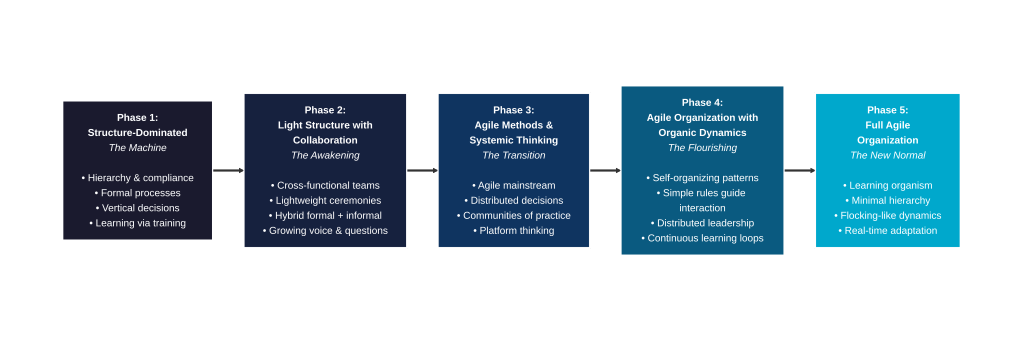
- AO or Agile Org is based on systems dynamics and Flocking Behavior (Boyd). It dissociates structure from organization. It proposes a transformation way in 5 steps to reduce structure to its minimal necessary level.
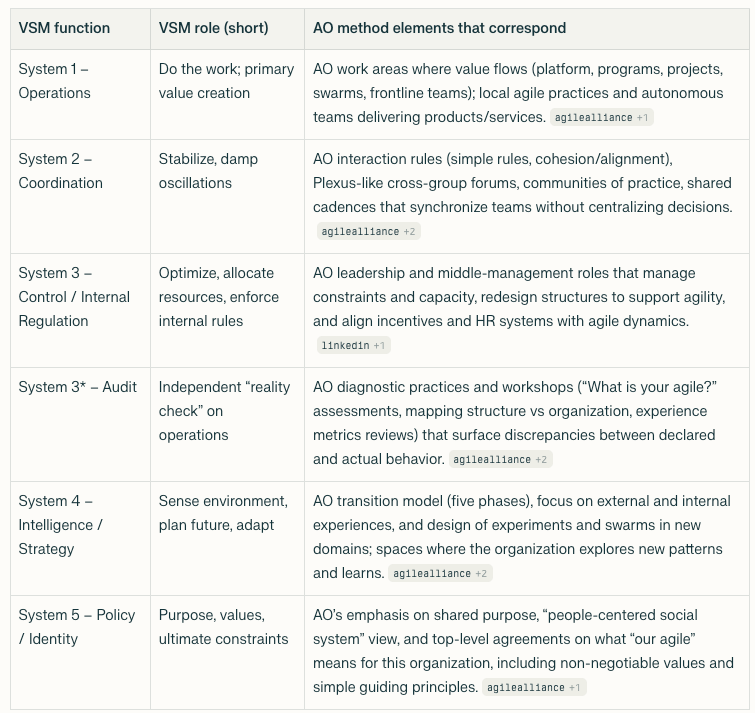
AO functions can be mapped to Beer’s six VSM functions in a meaningful way. This is done by treating AO as the “agile operating system” inside a viable organization. Below is a concise mapping.
AO vs VSM at a glance
- VSM distinguishes six key functions: Operations (1), Coordination (2), Control/Internal Reg (3), Audit (3*), Intelligence/Strategy (4), Policy/Identity (5).
- AO provides work areas, leadership practices, and transition/experience mechanisms that can fill these slots in an agile, human‑centric way.
Mapping table
Notes on fit and emphasis
- AO is strongest in System 1 (operations). It is also strongest in System 2 (coordination) through its work areas and interaction patterns. It makes everyday agility tangible.
- It also contributes to Systems 3 and 4 by framing transitions, leadership behavior, and experiments. However, this is often done in narrative/practice terms rather than explicit cybernetic structures.
- System 5 appears in AO’s insistence on organizations as social systems. These systems have an explicit purpose, identity, and human-centric norms. These norms constrain and legitimize all other AO functions.
 AO – Adaptive Organizations
Leave a comment