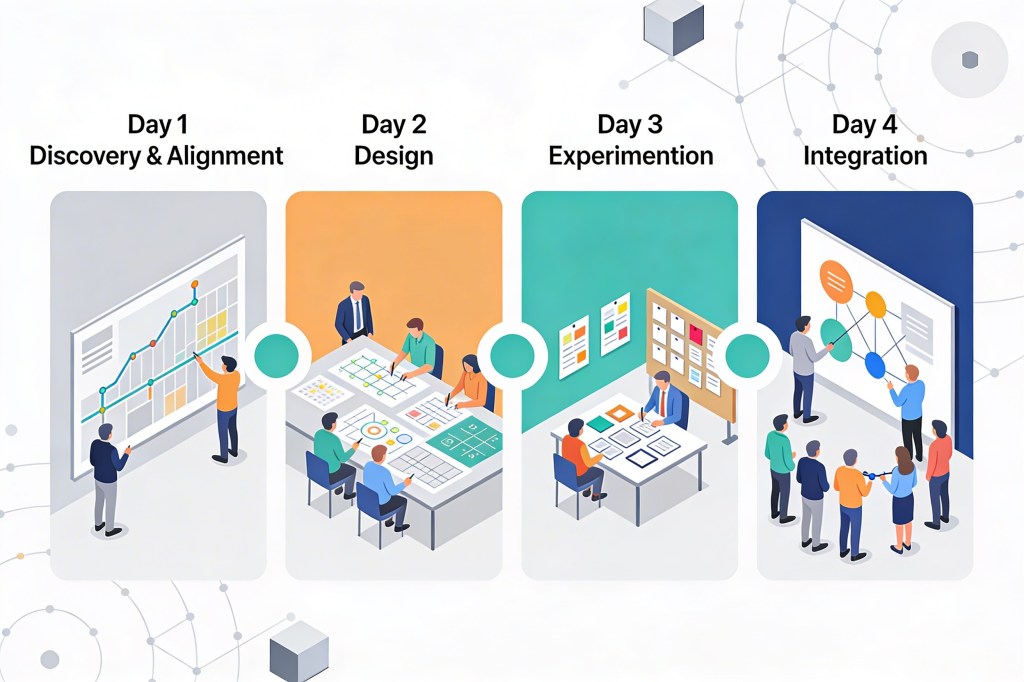
The AO Method Training Program is a comprehensive 2–4 day intensive. It is designed to equip leaders in organizational transformation. These include coaches, designers, HR professionals, executives, and consultants. The program provides the knowledge, skills, and tools needed to lead effective agile transformations. It utilizes the AO (Agile Organizations) Method.
This complete guide integrates curriculum design, learning objectives, and facilitator resources. It includes participant materials, a business model, and assessment frameworks. All these elements form one master reference document.
“Organizations need systemic transformation that integrates culture, structure, leadership, and processes—not just team-level agile practices.”
Knowledge Objectives (Understand AO)
Participants will be able to:
- Describe the purpose, scope, and core principles of the AO Method. Distinguish it from team-level agile frameworks such as Scrum or SAFe.
- Explain how AO frames organizations as complex, adaptive systems and why systemic thinking is essential for sustainable agility.
- Identify the key structural, cultural, leadership, and process dimensions that the AO Method addresses in organizational transformation.
Analytical Objectives (Diagnose and Design)
Participants will be able to:
- Assess an organization’s current level of agility and readiness for AO-style transformation using structured diagnostic lenses (structure, leadership, culture, networks, value streams)
- Map critical system dynamics (feedback loops, constraints, informal networks) that shape behavior and outcomes in the organization
- Compare different organizational design options (product-centric vs function-centric, networked vs hierarchical) and evaluate their fit with AO principles in a given context[5]
Applied Objectives (Intervene and Facilitate)
Participants will be able to:
- Design an initial AO-aligned transformation approach for a real or simulated organization, including entry strategy, pilots, and feedback loops[4][6]
- Facilitate core AO practices such as collaborative diagnosis, sociogram/network mapping, pilot framing, and retrospectives across teams and functions
- Apply AO-consistent leadership and coaching behaviors (enablement over control, creating psychological safety, shared sense-making) in realistic scenarios
Behavioral & Leadership Objectives (Embody AO)
Participants will be able to:
- Demonstrate the ability to shift between expert, facilitator, and coach stances depending on what the system needs during a transformation
- Practice decision-making that balances local autonomy with system-level coherence, in line with AO governance principles
- Model transparency, experimentation, and learning in how transformation work is planned, communicated, and adapted
Outcome & Impact Objectives (Sustain AO)
Participants will be able to:
- Define meaningful outcome metrics for AO-oriented transformations (adaptability, decision latency, learning speed, engagement, cross-functional flow) and link them to business goals
- Construct a 90-day AO transformation roadmap for one organization, including milestones, risks, and feedback mechanisms
- Identify personal development goals and next steps (supervised practice, peer learning, accreditation pathway) to continue growing as an AO-capable transformation leader
4-Day Intensive Training Curriculum
Module 1: Foundation Layer (Days 1-2)
- Session 1.1: What is the AO Method?
- Session 1.2: Core Principles of the AO Method
- Session 1.3: Systems Thinking Fundamentals
- Session 1.4: Organizational Archetypes & Assessment
- Session 2.1: The Agile Mindset & Behaviors
- Session 2.2: Leadership in Agile Transformations
- Session 2.3: Change Management in AO Transformations
- Session 2.4: Sociology of Organizations & Networks
Module 2: Implementation Layer
- Session 3.1: Organization Design Principles
- Session 3.2: Process Redesign & Workflow Optimization
- Session 3.3: Transforming Leadership Practices
- Session 3.4: Culture Change & Behavioral Anchoring
Module 3: Application & Coaching Layer
- Briefing & Roles
- Diagnose Through the AO Lens
- Design AO Programs, Work Areas, and Swarms
- AO Process Workshop Simulation
- Swarming Practice (Live)
- Debrief & Integration
Pre-Work & Readings
- Mandatory AO-Specific Core Reading
- “The New Normal – AO Concepts and Patterns of 21st Century Agile Organizations” – Excerpts (10-20 pages)
- Focus sections: AO hypothesis, five AO areas (structure, agile dynamics, transition phases, experiences, work areas)
- Purpose: shared conceptual vocabulary before day 1
- “AO (Agile Organizations) — Core Elements & Structure” – LinkedIn Article by Pierre E. Neis
- Summary of hypothesis, key constructs, adoption path, organizational stereotypes
- “The New Normal – AO Concepts and Patterns of 21st Century Agile Organizations” – Excerpts (10-20 pages)
- Recommended Short AO Articles
- “The AO Process” (agile-organization.com)
- Focus: recurring questions/metrics at each level, “chaos” data feeding collective workshop, “designing the alliance”
- “AO Programs” (agile-organization.com)
- Focus: Value/R&D/BAU streams, crowd-based roadmap building, roles of coaches and Product Owners
- AO related Books (Coupon for free download after registration) here
- “The AO Process” (agile-organization.com)
- Organizational Snapshot (Pre-Work Assignment)
- Each participant completes 1-2 page snapshot:
- Organization description (size, sector, products/services)
- Current structure at high level
- 2-3 current transformation or agility challenges
- Perceived maturity/readiness rating (1-5 scale) with justification
Key Tools & Templates for Organizational Redesign
- System & Context Mapping
- People & Network Tools
- Work & Flow Tools
- Structural Design Tools
- Transition & Experiment Tools
Assessment & Competency Measurement
- Understanding of Agile & AO Principles
- Systems/Organizational Thinking
- Diagnostic & Design Skills
- AO Work-System Competence
- Transition & Experimentation Ability
- Facilitation & Collaboration
 agile-organization.com